Amalia Wojciechowki, assistant director and collections curator
Cubist painter Georges Braque (1892–1963) famously commented, “Le vase donne une forme au vide, et la musique au silence” or “the vase gives shape to emptiness, and music to silence.” In discussing the vase, Braque uses it as a metaphor for art-making at large, or the artistic act of shape-making. On its face, though, we might think of the quote more literally as an injunction to more thoroughly consider the vase as a fundamental expression of form. While we tend to think of them as simple containers, the vase offers endless variety.
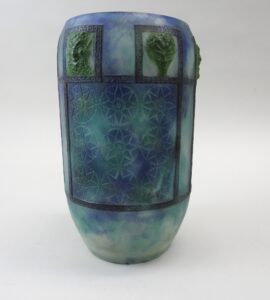
G. Argy Rousseau, Vase, 1922, glass, Museum purchase with funds provided by John and Alice Woodson Forester
In Form & Flower, on view now in the San W. Orr, Jr. Decorative Arts Gallery, vases spanning time and style offer a snapshot of the myriad shapes that can be expressed in glass and ceramic. From makers like Gabriel Argy-Rousseau (1885–1963), a pioneer in glass and ceramics who bridged the Art Nouveau to Art Deco periods, to René Lalique, a jeweler and master glass designer, who elevated nature motifs to Art Nouveau icons, the vases in Form & Flower become deeply expressive objects of their time’s styles and tastes.
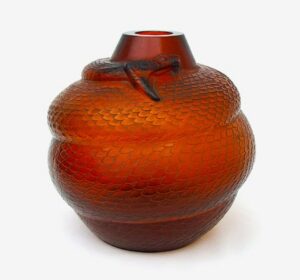
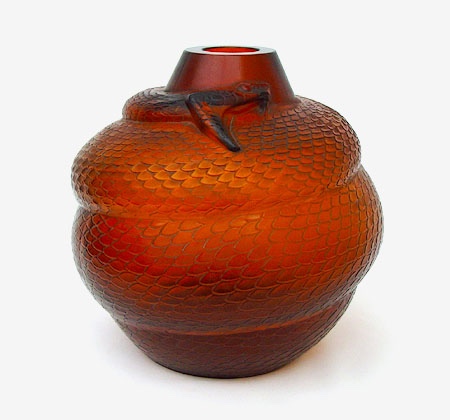
René Lalique, Serpent Vase, ca. 1925, glass, Museum purchase with funds provided by John and Alice Woodson Forester
Charles Schneider’s (1881–1962) Cameo Vase is one of my favorite examples of how the vase often began to anticipate its intended use through the shapes and motifs artists chose. Schneider, a French glass designer whose bold colors, intricate patterns, and sculptural forms are emblematic of the Art Deco period, creates a striking design in the pâte de verre glass paste method, building up layers of amber-colored glass to represent a thicket of drooping trumpet flowers.
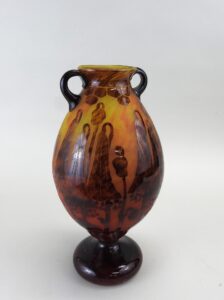
Charles Schneider, Cameo Vase ca. 1922–26, glass, Museum purchase with funds provided by John and Alice Woodson Forester
Beyond their formal qualities, then, vases also embody purpose. Decorative arts are frequently exhibited in gallery settings separated from their original functions; for example, quilts are displayed on walls and porcelain tea sets are placed under vitrines. In this exhibition, however, flowers emerge from the vases, activating them through their intended use. As the vase gives shape to emptiness, the flowers articulate the negative space surrounding the vessel, allowing both vase and flower to “give shape to emptinesss.”
Want to receive Woodson Wanderings directly to your email inbox? Sign up for our blog emailing list today!