

Amalia Wojciechowski, assistant director and collections curator
By the time American Modernist painter Marsden Hartley returned to the rocky coast of Maine in the last years of his life, he called himself, with characteristic pride, a “Maine-iac.” The nickname was more than a joke. Maine had become inseparable from his art and identity. During summers spent in Corea, Maine, Hartley turned away from grand landscapes and toward humble objects close at hand—wooden bird decoys, dead game birds, and weathered keepsakes. Between 1938 and 1941, he painted a small group of six related decoy pictures. Among them, Black and White Decoys, now in the Museum’s collection, is perhaps the sparest and quietly affecting.
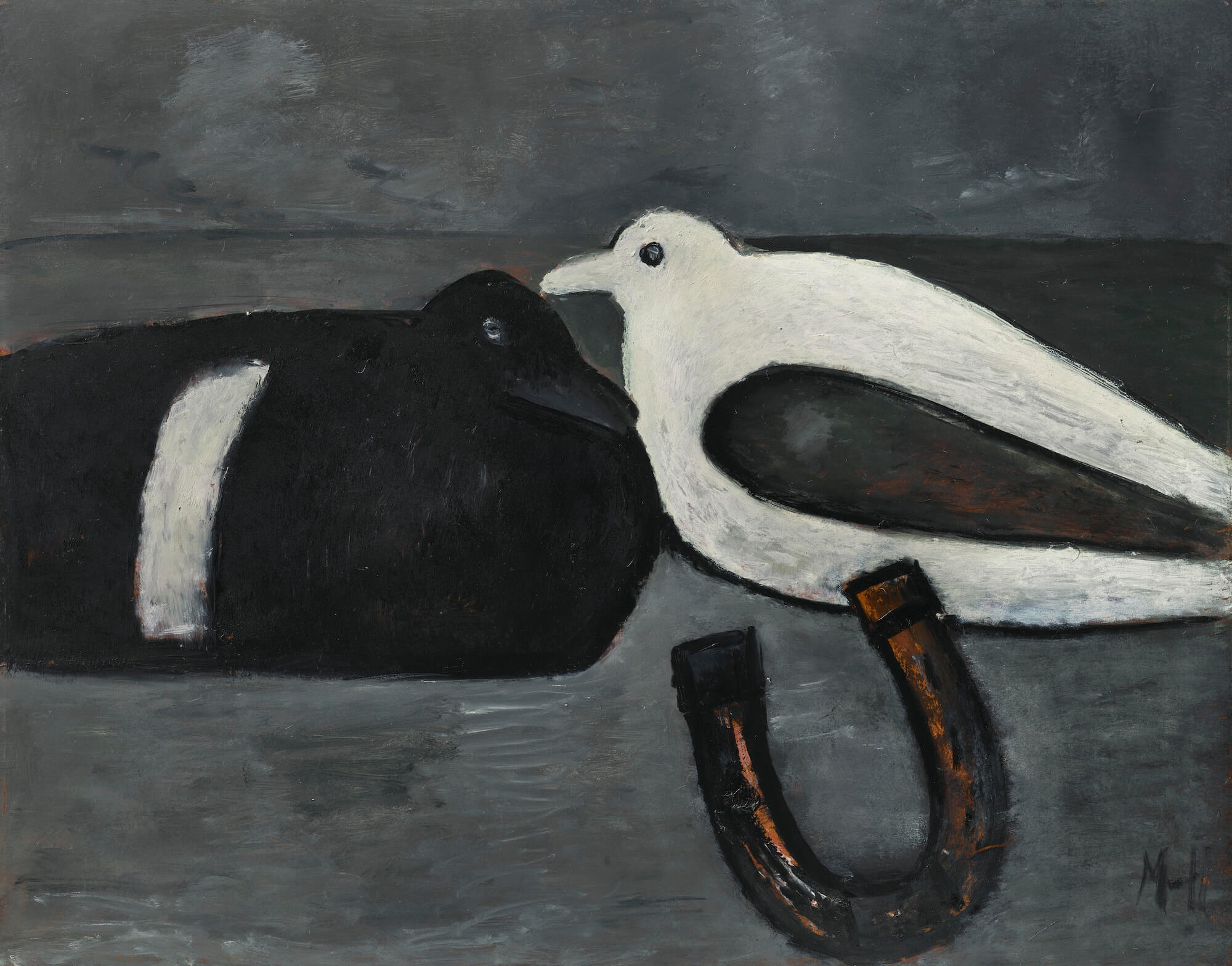
Marsden Hartley, Black and White Decoys, oil on Masonite, ca. 1940–41, Leigh Yawkey Woodson Art Museum, Museum purchase with funds provided by the Nancy Woodson Spire Foundation
At first glance, the painting seems simple: two decoys—one black and one white—occupy nearly the entire picture plane. Below them rests a horseshoe. Yet Hartley transforms these ordinary objects into something monumental. The composition is tightly cropped. The birds extend beyond the edges of the painting, as though the viewer has encountered them unexpectedly on a tabletop or dockside bench. A high horizon cuts across the upper edge, suggesting sea and sky dissolved into mist. The gray background is almost monochromatic, but it shifts subtly in tone and texture. Rather than describing a specific place, it evokes the atmosphere of coastal Maine—fog rolling over the bay, smooth water under heavy clouds, forms emerging and disappearing in the distance.
Hartley likely painted the work on unprimed Masonite, as he did with other paintings during this period, laying down a warm, dark ground that peeks through between the objects. Thick black outlines give weight and permanence to the forms. Color is restrained, but seeps through the images of the decoys in ruddy, rust-colored passages.
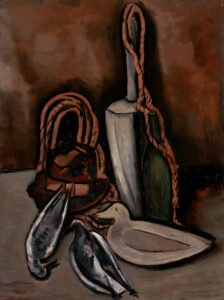
Marsden Hartley, Maine Coastal Still Life, oil on Masonite, ca. 1938, Wichita Art Museum
The horseshoe appears in another painting from this series, and its inclusion here is significant. Birds have long carried associations with mortality in still-life traditions, and Hartley, increasingly reflective in his final years, understood that symbolism. Yet the horseshoe introduces another note. Traditionally associated with good fortune, it tempers any melancholy with hope. Death and renewal exist side by side.
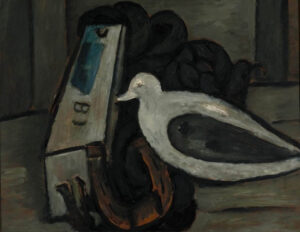
Marsden Hartley, Duck Decoy with Buoy, oil on composition board, ca. 1941, private collection
Painted during his final summers in Maine, Black and White Decoys distills a lifetime of looking into a few elemental forms. Nothing extraneous remains. Two birds. A horseshoe. A horizon line. Out of these simple things, Hartley created an image that feels at once deeply rooted in the coast of Maine and profoundly timeless—a quiet meditation on memory, mortality, and the enduring power of place.