

Amalia Wojciechowski, assistant director and collections curator
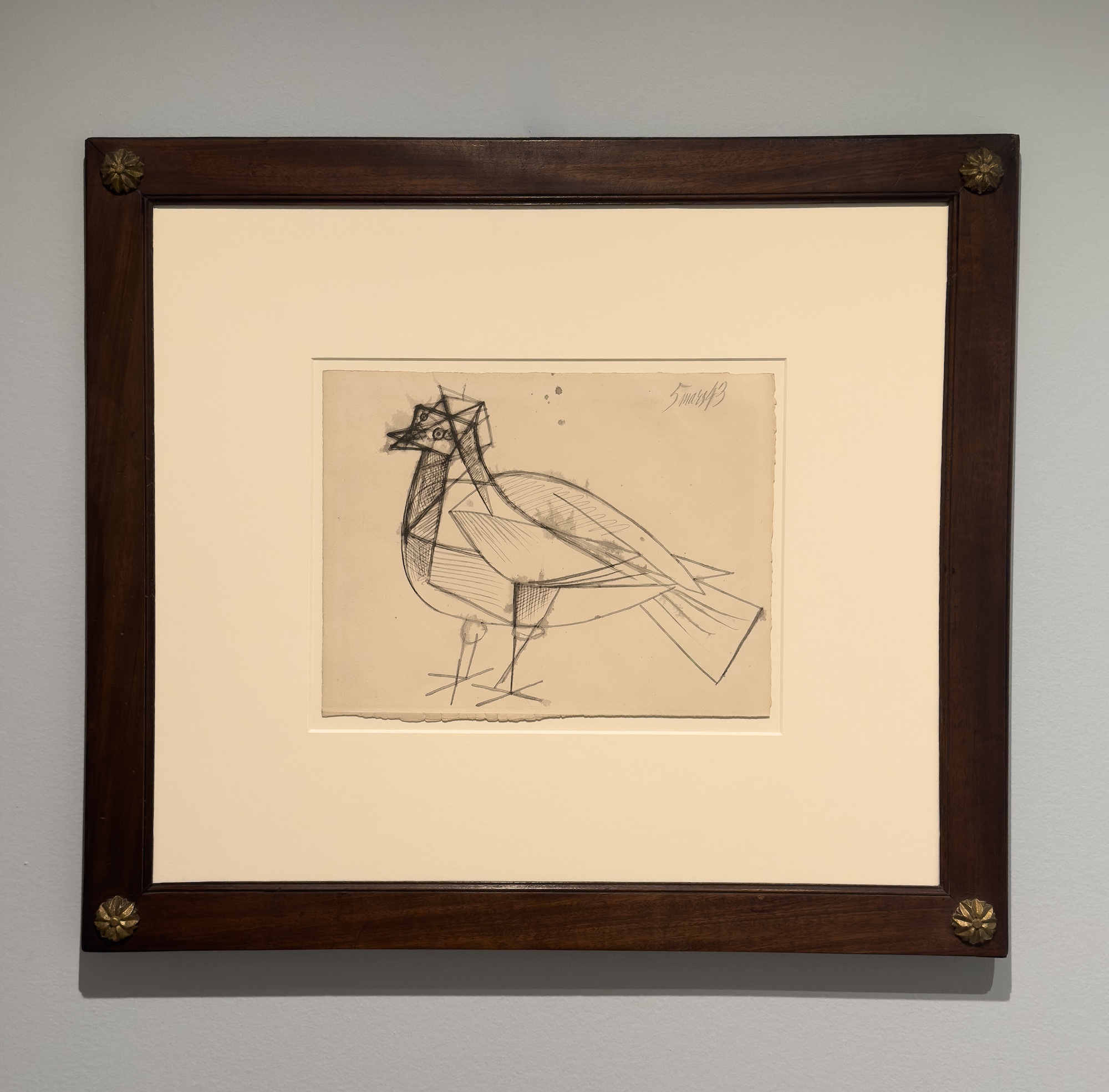
For Spanish artist Pablo Picasso, pigeons and doves were far more than incidental studio subjects. From Spain to Paris, from the shadows of war to the sunlit terraces of the South of France, the image of the pigeon followed him constantly. Now, one of Picasso’s pigeons has followed us here, to the Leigh Yawkey Woodson Art Museum. Recently acquired, Picasso’s Pigeon (1943, India ink on paper) is a testament to a deeply intimate motif for the artist.
Pablo Picasso, Pigeon, 1943, India ink on paper, Museum purchase with funds provided by the Nancy Woodson Spire Foundation
The roots of Picasso’s perpetual fascination began with his father, José Ruiz y Blasco, an artist and teacher whose own paintings often depicted pigeons and doves. He also kept pigeons, and the birds became embedded in Picasso’s visual world from an early age. According to a famous, if apocryphal, story, Picasso painted a group of pigeons so skillfully at the age of thirteen that his astonished father handed over his own palette and brushes, symbolically recognizing his son’s extraordinary talent. Years later, Picasso would describe the countless pigeons and doves that populated his art as a kind of “repayment” to his pigeon-fancying parents—a lifelong gesture of remembrance and devotion.
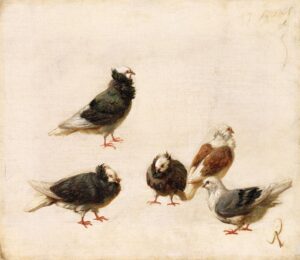
José Ruiz y Blasco, Pigeons, 1850, oil on canvas
Like so much in Picasso’s work, the pigeon transformed alongside him. It appears amid the splintered planes of Analytical Cubism in Pigeon with Peas (1911), then reemerges decades later in the luminous atmosphere of the South of France, drifting through open studio windows flooded with Mediterranean light. At La Californie, his villa in Cannes, Picasso built a dovecote on the third-floor balcony and painted a remarkable cycle of young pigeons inhabiting the loft just beyond his studio—a quiet dialogue with fellow artist Henri Matisse.
The pigeon also endured beside Picasso during some of the darkest years of the twentieth century. While many artists fled occupied France, Picasso remained in Paris throughout the German occupation, continuing to live and work at 7 Rue des Grands-Augustins. During 1942 and 1943, especially, pigeons and views from his studio window became recurring presences in his art. In those difficult years, Picasso’s relentless stream of drawings, prints, and paintings became less a sequence of isolated works than a visual diary—fragments of observation and daily life set down against the backdrop of war. Pigeons appear repeatedly: December 4, 1942; March 5, 1943, August 9, 1943.
Across these decades, the pigeon became one of Picasso’s most tender and lasting symbols. We’re pleased that we can count his Pigeon as part of the Woodson’s collection—a small but resonant trace of an artist who carried the memory of these birds with him throughout his entire life.