

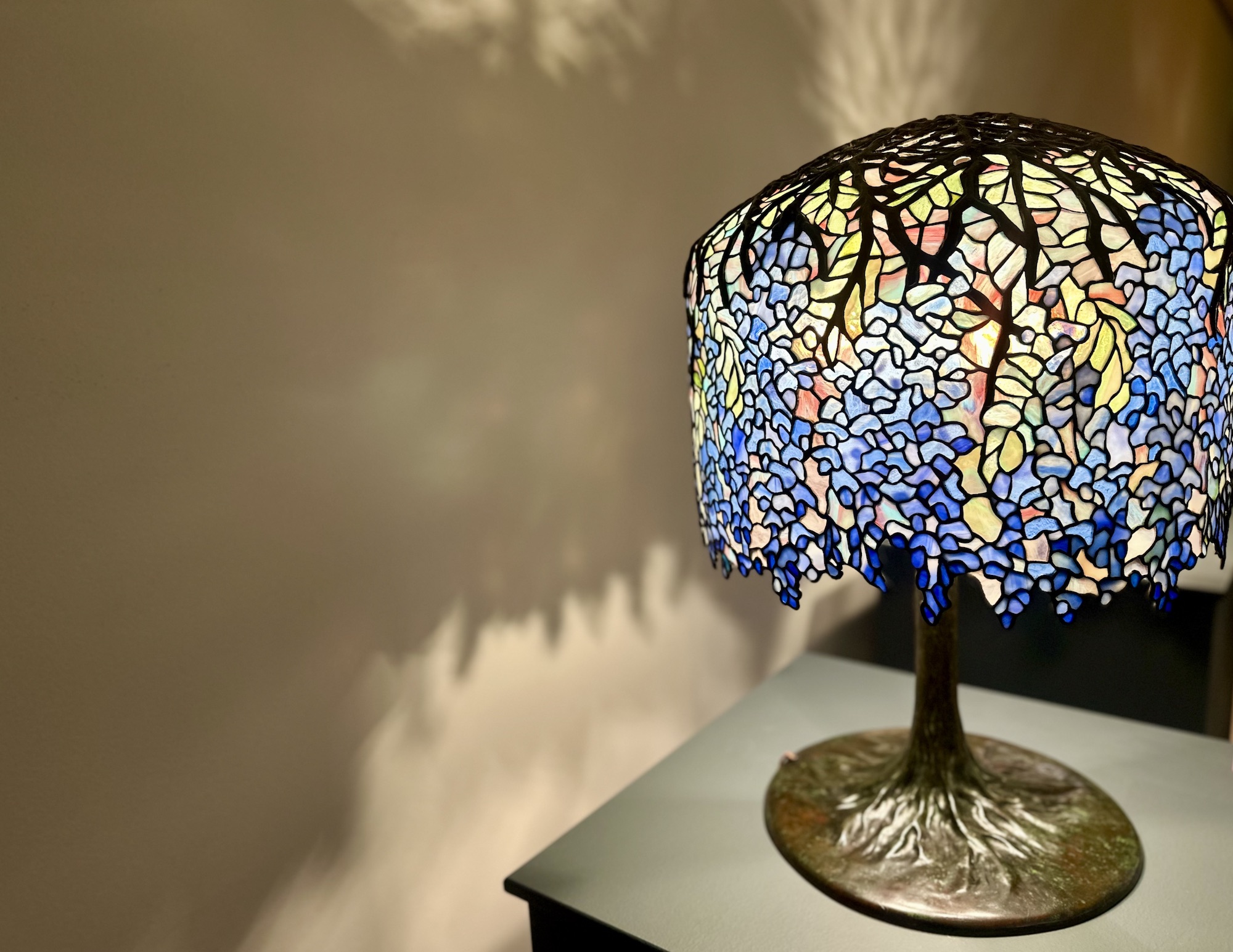
Amalia Wojciechowski, assistant director and collections curator

Installation photos of Tiffany or Ti-Phony?: A Story of Desire organized by The Neustadt Collection of Tiffany Glass, Queens, New York.
This idea extends beyond individual artworks and into the spaces where we encounter them. In exhibitions, negative space appears as breathing room: the pause between works, the expanse of empty wall, the moment when nothing demands interpretation. Absence, in this context, becomes a curatorial tool.
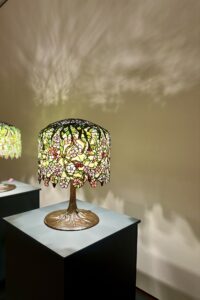
Installation photos of Tiffany or Ti-Phony?: A Story of Desire organized by The Neustadt Collection of Tiffany Glass, Queens, New York.
In Tiffany or Ti-phony? A Story of Desire, on view at the Woodson starting on Saturday, the glow of light on an empty wall becomes a silent guide between the brilliant glass lamps. With 45 lamps from The Neustadt’s renowned collection, the exhibition invites you to compare objects that radiate against the quiet of the gallery surface—and then invites you to pause, step back, and let the lamps’ colors and forms resonate in the calm around them. It’s in those quiet moments that you notice how the light plays on the wall itself, how that warm gleam lets each lamp assert its presence without overwhelming the space.
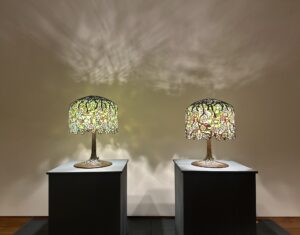
Installation photos of Tiffany or Ti-Phony?: A Story of Desire organized by The Neustadt Collection of Tiffany Glass, Queens, New York.
In a world saturated with images and information, negative space can feel almost radical. It resists speed and excess. Whether on a canvas or in a gallery, it asks us to notice not just what’s there, but how we are being guided to see it. Sometimes the most generous thing an artwork—or an exhibition—can offer is space enough to let meaning arrive on its own.