

Amalia Wojciechowski, assistant director and collections curator
March, as Women’s History Month, invites us to reconsider the stories we have inherited and to ask who, historically, has been framed in the foreground and who has been cast in shadow. For many women artists of the nineteenth and early twentieth centuries, artistic training began within male-dominated circles: a studio, a lecture hall, a family workshop. What is remarkable is not that these women learned from men—it is how decisively they stepped beyond them. Through mentorship, sibling partnership, and family tradition, artists like Fidelia Bridges, Elisabeth Rungius Fulda, and Maud Earl, each represented in the Woodson Art Museum’s collection, transformed proximity to male counterparts into independent achievements and creative identities.
In 1860, encouraged by sculptor Anne Whitney, Fidelia Bridges attended lectures by artist William Trost Richards at the Pennsylvania Academy of the Fine Arts. Richards, a leading voice in the Pre-Raphaelite movement in America, emphasized close observation and painstaking detail—principles that would profoundly shape Bridges’ art. Bridges formed a personal friendship with Richards and accompanied his family on painting excursions. He also supported her career materially, introducing her to patrons and helping secure sales. Yet Bridges did not remain merely a student in his orbit. She absorbed the Pre-Raphaelite devotion to nature and made it wholly her own. Her studies of birds, butterflies, and blossoms were neither imitations nor adjuncts to Richards’ practice. They were distinct, intimate, and unmistakably hers. By 1873, Bridges was elected an associate of the National Academy of Design, only the second living woman to achieve that distinction. Critics compared her work favorably to Winslow Homer; Henry James described her paintings as “infinitely finer and more intellectual.”
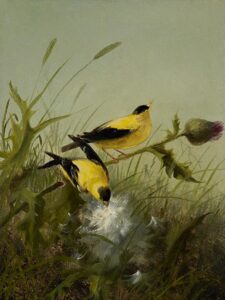
Fidelia Bridges, Goldfinch and Thistle, ca. 1865, oil on canvas, Museum purchase with funds provided by the John and Alice Forester Charitable Trust
Elisabeth Rungius Fulda’s artistic path began in Berlin, encouraged by her elder brother Carl Rungius, who would go on to become a celebrated wildlife painter. In a period when formal academic access for women was limited, Elisabeth trained privately with Carl and his associates, like Richard Friese and August Gaul. Her brother’s advice— “never praise your own work”—remained with her for life, shaping her discipline and her humility. Elisabeth’s story is not a footnote to her brother’s. After emigrating to the United States and studying at Cooper Union and later the Art Students League, she built a career that bridged art and science in pioneering ways. At the American Museum of Natural History, she worked as both artist and photographer. Beyond the museum, Fulda exhibited widely, collaborated with national institutions, and became the Society for Animal Artists’ first president in 1960.
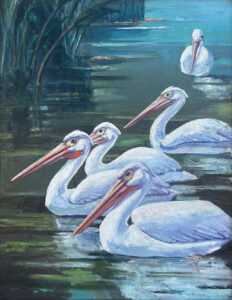
Elisabeth Fulda, Five Pelicans, 1925, oil on canvas, Museum purchase with Tribute Funds
Born into a family of animal painters in Victorian England, Maud Earl was trained first by her father, George Earl, a noted sporting artist and avid member of The Kennel Club. Under his guidance, she studied anatomy rigorously, sketching the skeletons of dogs, horses, and humans to hone her understanding of structure and movement. She later credited this instruction as foundational, setting her apart from other animal painters. Like Bridges and Fulda, Earl did not remain a daughter in her father’s studio. She formalized her training at the Royal Female School of Art and went on to exhibit at the Royal Academy, the Royal Society of British Artists, and the Paris Salon. In 1897, she mounted an ambitious exhibition of forty-eight different dog breeds—a tour de force that demonstrated not just technical command but also encyclopedic knowledge of her subject. At a time when women were rarely expected to earn a living as painters, Earl cultivated an elite clientele that included Queen Victoria and Queen Alexandra. Her images circulated internationally through engravings and books. After World War I, she emigrated to New York, where she continued her career and achieved international recognition.
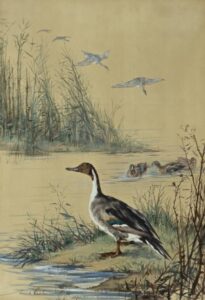
Maud Earl, Pintails, ca. 1933, watercolor and gouache, Museum purchase with funds provided by the Nancy Woodson Spire Foundation
What distinguishes Bridges, Fulda, and Earl is not their proximity to male artists—it is their refusal to remain defined by it.